- Learn Prompting's Newsletter
- Posts
- The AI Race Just Shifted Again
The AI Race Just Shifted Again
How Claude Opus 4.6 pushes agentic AI, coding, and reliability forward
Learn Prompting Newsletter
Your Weekly Guide to Generative AI Development
Claude Opus 4.6 Just Shifted the AI Race
Learn how Claude Opus 4.6 pushes agentic AI, coding, and reliability forward
Hey there,
The AI race has shifted. It's no longer just about having great chatbots and instead now includes agentic tools like Codex and Claude Code. Anthropic’s new frontier model, Claude Opus 4.6, was created with this fact in mind. It can work on multiple complex tasks simultaneously while being smart enough to budget its extended thinking for only the most difficult tasks. Let’s take a closer look at what makes this one of the best frontier models.
The Upgrades Powering Opus 4.6
Claude Opus 4.6 isn’t a minor refresh; it's a major leap forward in both agentic capabilities and long-context reasoning.
State-of-the-Art Agentic Coding:
Opus is now the leading model for agentic coding. Anthropic shared that Opus 4.6 scored the highest score ever on the Terminal-Bench 2.0 evaluation. This benchmark focuses on a series of terminal based actions.
This improvement means that Opus 4.6 is now better at planning larger tasks which is essential for Claude Code and Cowork. It's also better at working within large codebases and has the capacity to debug both your code and its own. Effectively this update means that Claude can now handle more complex coding tasks from start to finish with significantly less human intervention.
Larger Context Window:
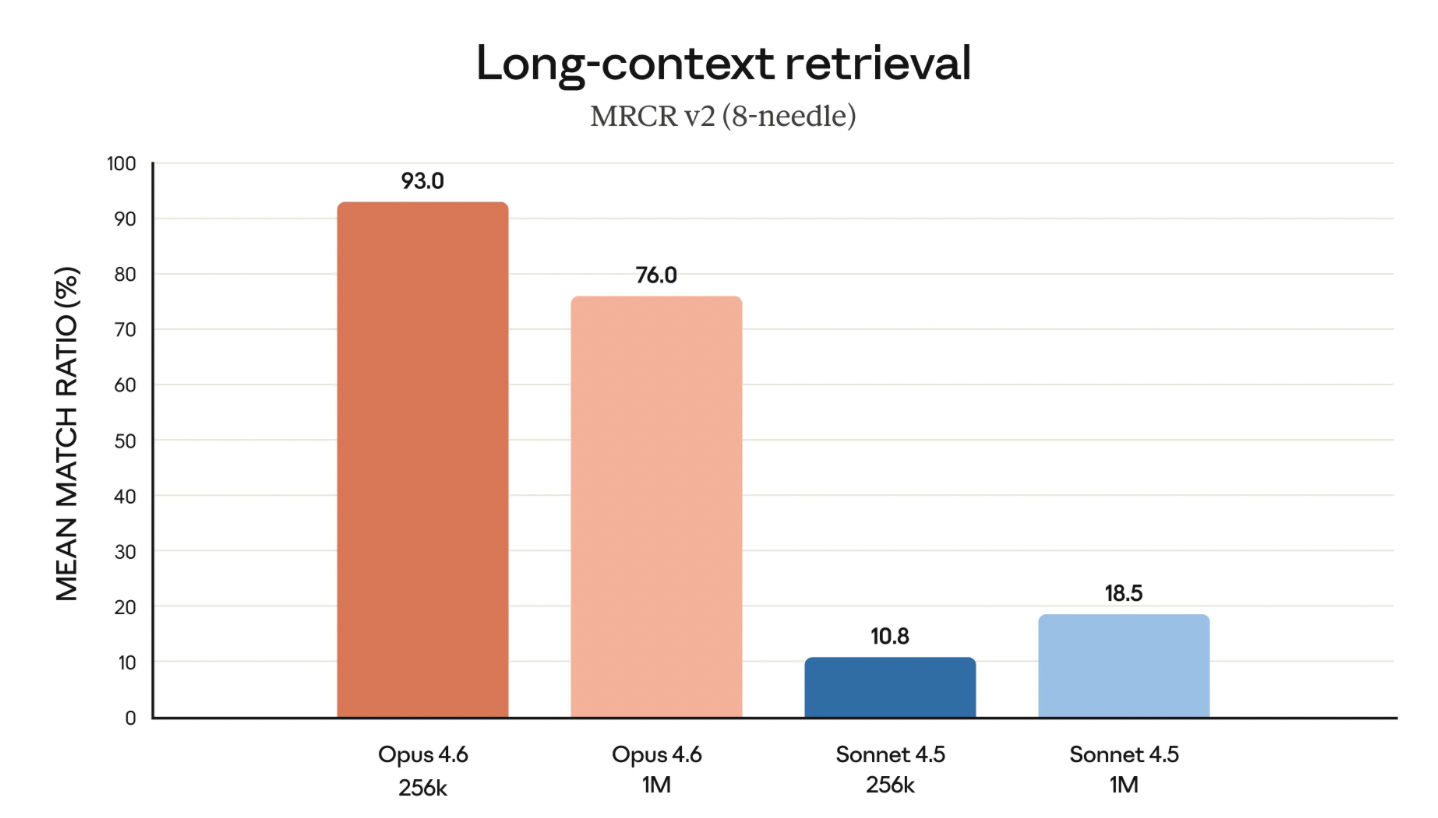
Claude Opus 4.6 has a larger, 1 million token context window. Perhaps more importantly, this new model is also better at retrieving information from within this massive context window. Having this ability is essential because many users have noticed substantial decreases in quality when conversations hit a certain threshold.
Opus 4.6 performs markedly better than its predecessors: on the 8-needle 1M variant of MRCR v2—a needle-in-a-haystack benchmark that tests a model’s ability to retrieve information “hidden” in vast amounts of text—Opus 4.6 scores 76%, whereas Sonnet 4.5 scores just 18.5%
Being able to process and recall more information means that Opus 4.6 is the ideal choice for autonomous work. The model can remember the important details of its task while also comprehending entire codebases or source materials.
More Efficient Thinking:
Opus 4.6 comes with new “adaptive thinking” which allows the model to determine whether or not to use extended thinking. This means that the model won’t waste time and tokens over-analyzing simpler prompts and will instead budget its extended thinking for more complex tasks. Anthropic has also added new “effort” controls that “give developers more control over intelligence, speed, and cost”.
Increased Reliability:
Anthropic’s focus on model reliability has resulted in less “misaligned behavior”. This translates to fewer hallucinations, deceptions, and most importantly, sycophancy. Opus 4.6 will prioritize giving accurate, factual responses instead of going along with whatever the user says.
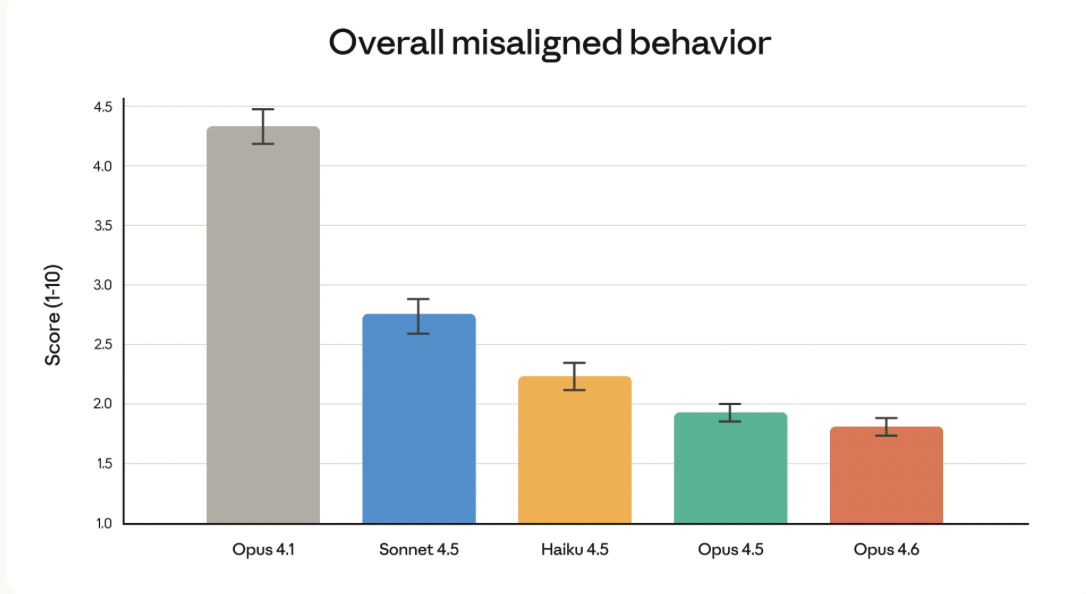
Misaligned behavior includes: deception, sycophancy, encouragement of user delusions, and cooperation with misuse.
How does this impact you?
In practice, an upgraded Opus 4.6 means a direct upgrade to Claude Code and Cowork.
Claude Code:
The increase in coding abilities means Claude code can more effectively interact with your terminal while “agent teams” allow multiple agents to work together on complex tasks. The larger context window ensures that your entire project as well as your complex instructions are remembered and accurately followed. Whether it's writing code, debugging it, or simply helping you complete your tasks, Opus 4.6 helps ensure that Claude Code stays state-of-the-art.
Cowork:
The upgrades of Opus 4.6 mean that Cowork can now complete an even wider range of tasks. It performed better than other frontier models on tasks involving finance and legal knowledge. Similarly to Claude Code, Cowork can now complete simultaneous tasks autonomously, effectively increasing the usefulness by two or three times.
How to Access
Opus 4.6 is currently available to all paying subscribers. It can be accessed through Claude.ai and Anthropic’s API. Of course the most impactful place to use this new model is in Cowork and Claude Code.
We’re now hosting enterprise AI workshops for teams, starting at $12K, focused on responsible and effective AI use in business.
Contact Us →We’re also opening enrollment for our AI Red-Teaming Masterclass — designed for professionals in cybersecurity, DevOps, and app security, as well as technical leaders like CTOs and CISOs looking for hands-on AI security experience. The course is $1,199 per student with discounts available for bulk seats.
Enroll Now →My Thoughts:
Claude Opus 4.6 is a clear signal for the direction that AI will be heading in 2026. Agentic abilities are only going to become increasingly necessary to make a model competitive. Being better at autonomously completing tasks is the future of AI. We can see this when looking at the popularity of tools like Claude Code, Codex, and Moltbot. I believe that reducing “misaligned behavior” is also essential for a model's success. I think Anthropic is leading the AI race in its commitment to making models more reliable and secure. I’m hoping we see these kinds of changes across the board in 2026.
As a big fan of Claude Cowork, I’m looking forward to seeing how this new model will improve the tool. You can start testing Opus 4.6 right now by heading over to Claude.
Reply